Undetectable Bloodstains Now Can be Visualized Through New CSI Technology

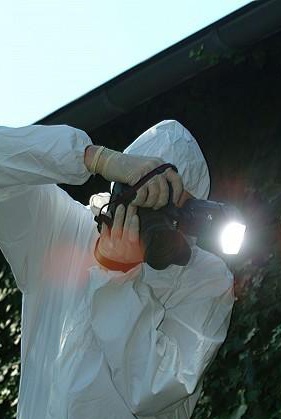
A picture is said to be worth a thousand words.  What about a camera that can actually have the ability to see the invisible, and more?  Chemists from the University of South Carolina are developing a camera that will reveal what the naked eye can’t see.  Crime scene investigation is evolving with some of these new techniques becoming available.  

This new technique is called multimode imaging in the thermal infrared.  This technology uses photographic images in several different ways.  It captures hundreds of invisible images in just a few seconds, while illuminating the subjects with pulses of invisible infrared light waves.  In addition, some of these images are taken with special filters that can block out certain wavelengths making it possible to block out certain objects in the background.  It can actually detect blood that has been diluted to as little as one part blood to 100 parts water.  That’s quite impressive.

Michael Mynick, Stephen Morgan and their graduate student colleagues explain that the luminol (chemical used for detecting blood stains and other substances at a crime scene) test has disadvantages for being potentially toxic, can’t detect certain diluted substances, and provide false positives. 

One of the most impressive aspects of this type of photo imaging is that it can detect the difference between blood, household bleach, soda, coffee, and invisible fabric watermarks. 

The ACS Analytical Chemistry reports further states, “These results indicate that this system could be useful for crime scene investigations by focusing nondestructive attention on areas more likely to be suitable for further analysis.”    

It’s very encouraging to read about new and less toxic techniques to help investigators and forensic scientists identify a suspect from the crime scene.

Posted in Forensic | Tagged , , , , , , , | Leave a comment

Psychopaths Hide Behind a Mask of Normalcy

“Mankind has a natural predator, the psychopath, and this predator is invisible because there are no easily discernible markings that set him apart.”  The Trick of the Psychopath’s Trade: Make Us Believe that Evil Comes from Others. 

When we hear the word “psychopath” we envision a creepy, murdering monster, but psychopaths blend into society in all walks of life and professions.  They are not ALL serial killers of course, but they do leave a path of destruction and broken dreams in their wake.   Unfortunately, I’ve met more than my fair share of these individuals and it has driven me to study them.  I like to feature these type of characters in my books.

What happens when we “unmask” the psychopath?  What we find are antisocial personality and relates syndromes.  The Hervey Cleckley checklist has made a profound impact on the way we think about psychopathy.  His empirical research has influenced the way we view the disorder.

Cleckley and many other researchers contributed interesting assessments and research into psychopathy with the temporal gradient to fear arousal, various ratings of psychopathy, patterns of autonomic activity, sensory input, and perceptual-cognitive factors.  All of these aspects contribute to the psychopathy checklist.

It has been estimated that approximately 1% of our society fits the true definition of a psychopath.  About 20% of incarcerated inmates are psychopaths.  It may be as high as 35-40% if you include inmates with anti-personality disorder, which have many of the same characteristics as psychopaths.    

The 20-item psychopathy checklist was revised in the 1980s and is still used today.  Here’s Cleckley Checklist in order of characteristics.

  1. Glibness / superficial charm
  2. Grandiose sense of self-worth
  3. Need for stimulation / proneness to boredom
  4. Pathological lying
  5. Conning / manipulative
  6. Lack of remorse or guilt.
  7. Shallow affect
  8. Callous / lack of empathy
  9. Parasitic lifestyle
  10. Poor behavioral controls
  11. Promiscuous sexual behavior
  12. Early behavioral problems
  13. Lack of realistic, long term plans
  14. Impulsivity
  15. Irresponsibility
  16. Failure to accept responsibility for own actions
  17. Many short-term marital relationships
  18. Juvenile delinquency
  19. Revocation of conditional release
  20. Criminal versatility      

Why do we find these types of individuals so interesting? 

I can’t speak for anyone else, but I find it fascinating how they can blend in to society like an evil chameleon.  Their behaviors, thought processes, and impulsiveness make for serious study.  My particular interest is in the predatory behavior of committing serial crime.  There is no doubt there will be a lack of information or psychopaths for this study, and hopefully it will continue to unlock the tightly wrapped brain process of the human psychopath.

Jennifer Chase
Award Winning Author & Criminologist
 
Posted in Criminology, Serial Killers | Tagged , , , , , | 3 Comments

New Forensic Technique to Help Catch Sexual Offenders


“If condom lubricant can be detected in fingermarks it would improve the evidence for prosecution by establishing the assailants present at the scene and, crucially, having had contact with the condom.  This would enable forensic scientists to provide further support to the evidence in alleged cases of sexual assault.”  Stated by Dr. Simona Francese from the Sheffield Hallam University’s Biomedical Research Centre, United Kingdom.

There has been an increase in the use of condoms by sexual offenders recently due to DNA identification and sexually transmitted diseases.  It seems that offenders are becoming increasingly aware that forensics can establish their identities in these cases.  By using condoms, these predators are hoping to outsmart law enforcement and forensics. 

A new technique being developed at Sheffield Hallam University can prove that a sexual offender had contact with a condom and place them at the crime scene.  This important link of the suspect is identified by their fingermark on the condom.  Through research, scientists have discovered that they can successfully detect lubricant from two widely available condom brands on fingermarks, even fingermarks left weeks before actual analysis.  Researchers used a powerful matrix-assisted laser desorption/ionisation mass spectrometry imaging system to map fingermark ride patterns. 

This new technique will have significant, positive results in sexual assault cases.  Evolving technology will continue to help aid forensics and crime scene investigation.  I hope that it will help to deter these heinous crimes in the process.

Posted in Forensic | Tagged , , , , | Leave a comment

Some of my Personal Favorite Books with Memorable Canine Characters

My latest release, Silent Partner, has a supporting character that just happens to be a police trained Labrador retriever.  Make no mistake, this story is a cop thriller.  I developed this particular thriller novel where the hero’s partner is a dog.  I personally felt that it actually heightened the suspense and gives readers a little insight into police K9 teams.   

I realized that there are many books that have made their way to my reading list over the years that have dogs incorporated into the story.  I’ve listed below some of the books where the canines have made a lasting impression. 

Here are a few:   

1.      The Incredible Journey by Sheila Burnford

The wonderful story of three pets, a cat and two dogs, who lose their owners when they are all on vacation. Can they find their way home?

2.      Where the Red Fern Grows by Wilson Rawls

A story about a boy who buys and trains two redbone coonhound hunting dogs.  I read this story when I was in the fourth or fifth grade.  I still remember it today!

3.      White Fang by Jack London

The story takes place in Yukon Territory, Canada during the Klondike Gold Rush at the end of the 19th-century, and details a wild wolfdog’s journey to domestication.  Great book.  (Available free on Amazon Kindle)

4.      Seize the Night by Dean Koontz

As you know by now, I’m a Dean Koontz fan.  One of things that I enjoy about his books is that he incorporates wonderful, intelligent dog characters into the mix.  This is the second book with character Chris Snow who is light-phobic.   

5.      Call of the Wild by Jack London

The plot concerns a previously domesticated dog named Buck, whose primordial instincts return after a series of events leads to his serving as a sled dog in the Yukon during the 19th-century Klondike Gold Rush, in which sled dogs were bought at generous prices.  Another great London book.  (Available free on Amazon Kindle)

6.      Cujo by Stephen King

Okay, this is for all of your Stephen King fans.  I enjoyed this scary tale of a nice, well-mannered St. Bernard… and well, you get the picture.

7.      Watchers & TickTock by Dean Koontz

Here are a couple more Koontz books to check out with some interesting, highly intelligent, government inspired, and even supernatural dogs.  In Tick Tock, I loved the hyper-intelligent black Labrador retriever.  I’m sure you can guess why!

8.      Harry Potter by J.K. Rowling

I enjoy all of the Harry Potter books, but I couldn’t leave out Hagred’s huge dog “Fang”. 

9.      The Wizard of Oz

Where would my memorable list be without the happy, little dog “Toto”?  “There’s no place like home… there’s no place like home…”

10.  Dog On It by Spencer Quinn

This is a newly discovered author for me of the Chet and Bernie Mysteries.  This particular canine narrates the adventure with his down on his luck, private eye, human partner.  A fun book that makes me giggle quite a few times during the story.

I would love to hear from you!  Tell me some of your favorite books with canines.

Posted in Writing | Tagged , , , , , | Leave a comment

Free Your Mind by Organizing Writing Goals for 2011 and Beyond

Clear you mind… 

Organize your writing space… 

Tidy up your computer file folders… 

Just let the ideas and writing begin to flow… 

It’s time to budget your writing goals.  Whether you’re a new or an experienced writer, there’s always a time that we need to take a good hard look at our projects.  If you want to work in a timely manner and finish your projects, you have to budget and work out your yearly goals.  Sorry, there’s no easy way around it! 

Yearly and multi yearly goals are a must!  Some people even budget three to five year goals.  I can’t seem to wrap my head around that, but projects are still simmering in the back of my mind for future projects.

I divide my yearly writing goals into three basic categories: writing, editing, and promotion.  Then I expand from there until I get my basic “to do” lists for a weekly or monthly schedule.  An important thing to remember is not to get down on yourself if you don’t follow your schedule exactly.  Praise yourself for writing and completing every task you set out to do. 

Generally, I have one specific novel that I concentrate on for the calendar year.  Sometimes another novel will spill into the current year, but that’s definitely okay and keeps the flow moving forward.  For 2011, I’m currently outlining and writing my third Emily Stone Novel, titled Dark Mind.  I’m very excited and can’t wait to get back into the head of Emily Stone along with a very disturbing, interesting serial killer.  As the year progresses, I will give updates on my progress and scheduled release date.     

Editing and promotion is a big challenge for writers.  Mapping out time to complete this is extremely important.  What are your goals?  How are you going to budget your time?  What new ideas are you going to incorporate into promotion this year?   

Along with writing, editing and promotion, there are other tasks that many writers want to accomplish.  For me, I will be hosting several writer’s workshop on “How to Write a Screenplay” along with some other appearances and talks.  These all have to be budgeted into the yearly overall goal. 

With a new year, there are also new schedules and procedures.  It’s always nice to revamp your usual routine.  It’s helps to breathe new life into your daily work schedule.  Are you going to write more or less per day?  Are you going to outline or not?  How many scheduled research trips/interviews do you have?

The best way to budget your yearly goals is to write down the basics and then break down individual tasks from your basic list.

Here’s to a very successful, productive, goal-oriented year!

Posted in Writing | Tagged , , , , | Leave a comment

How Can Henna Help Catch Criminals?

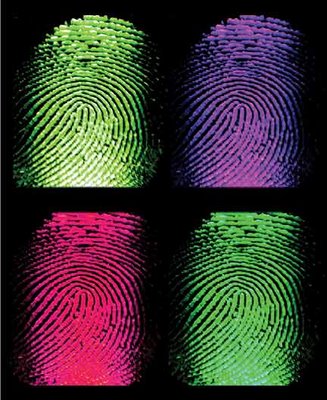
Fingerprints have been studied for uniqueness, identification and criminal importance for more than one hundred years.  The significance of fingerprints and the criminal justice system can’t be undervalued; they can implicate the guilty by linking a criminal to the victim and the scene of the crime and exonerate the innocent.  Through technology and expertly trained fingerprint examiners, the fingerprint can be the single most important piece of evidence for solving a crime.   

Fingerprints can be located and collected from three main groups: plastic fingerprints caused by a negative three-dimensional impression such as clay or wet paint, fingerprints contaminated with foreign matter such as blood or dust, and latent prints that is generally not visible to the naked eye and must be developed by one of various developing techniques.

Latent fingerprints left on a porous surface such as paper is usually detected by a chemical process called ninhydrin.  Ninhydin reacts to the amino acids secreted by the fingers and turns the invisibles fingerprints dark purple.  I’ve used this process to develop fingerprints on an anonymous letter sent to a victim.  The process takes several hours to develop.  And yes, the fingerprints were definitely matched to the perpetrator who was already in prison.  

Ninhydrin is an irritant and scientists are looking for a safer alternative.  Simon Lewis and colleagues at Curtin University of Technology in Australia have found a compound in henna that can work in a similar way to ninhydrin without causing irritation.  Henna is derived from the plant Lawsonia inemis and has been used for skin care, hair dye, and cosmetics without any ill effects for centuries. 

Lawson is the compound thought to be responsible for the staining properties of henna.  It has been found that the compounds react to the amino acids of invisible (latent) fingerprints.  The result is a brown-purple color and is strongly luminescent under a forensic light source.       

Research is currently under way along with new possibilities that may lead to improvements in fingerprint detection.  Nature is truly amazing and shouldn’t be underestimated.  I believe that most scientific answers can be found from nature.

Posted in Forensic | Tagged , , , , , , | 2 Comments

How to Prepare to Write a Screenplay


You have a movie idea in your head.  Maybe you even have some scenes worked out with the main character or characters.  And, maybe you even know how it’s going to end.  But you need to start at the beginning and build from there to end up with a solid screenplay.

It can be frustrating and tedious, but it’s important to start at the beginning and then prepare to write the screenplay.  There are great books out there that describe how to write a “selling” screenplay and how to layer your depth and pace of the story.  That still doesn’t answer how to prepare to write or the best way to outline so that you can see your story.

I have some tips for you to help you get started.  First, don’t look at the entire screenplay as a whole at the moment.  You need to get down to the nitty-gritty of the story.  It’s the simplified version. 

What’s your screenplay about?  Write down a few sentences or even a few paragraphs of the basic story.  Let it simmer for a while.  Do you have a story?  Keep adding to these ideas.

Let me make it even easier…

Start with the premise of the screenplay.  This is the foundation or principle idea of the storyline, which will ultimately become the completed screenplay.  Simply stated, this is where you begin to lay the groundwork.  Don’t think about the complexities at this point. 

Write down notes or the basic idea of a screenplay.  The premise will most likely change as you begin to develop your story.  You will begin to see what will work and what will not.  Keep the brainstorming process flowing by writing out these premises in your chosen genre.  Sometimes genres can overlap, like action/adventure or historical/drama.  Don’t worry about the overlapping genres right now.  Just start the process.

To begin with this step, write out basic ideas that interest you in one complete sentence.  Remember, keep ideas brief, and don’t go into any detail yet. You will find what works and what doesn’t for your screenplay.  On your computer or on 3×5 index cards, whatever media you prefer, jot down 10-20 simple ideas that interest you.

Sometimes just getting started can be the most difficult obstacle to overcome.  But once you start writing out ideas, believe me you won’t be able to stop.  It’s like opening the floodgates to creative writing.  The premise is what inspires and awakens the creativity of the screenwriter. 

 For more information and a complete step-by-step process of getting your first screenplay draft, check out:

How to Write a Screenplay:  A simple building block process to write a professional screenplay from beginning to end.

Posted in Screenwriting, Writing | Tagged , , , , | 2 Comments