Serial Killer Who Operated “Torture Truck” Avoids Death Penalty

In a state that is known for expediting the death of convicted criminals who have been given such a sentence by the court, one serial killer has reached a deal that will keep him alive but behind bars for the rest of his life.

A West Texas judge agreed to give Robert Ben Rhodes two life sentences for murdering a hitchhiking couple two decades ago.  He already is serving a life sentence for killing a 14-year-old girl in Illinois, who he murdered with baling wire and a piece of lumber, so there is assurance that, either in Illinois or Texas, Rhodes never will experience life around a prison cell again.

Rhodes picked up a newlywed couple outside of El Paso back in 1990 as they traveled from Seattle to Georgia as evangelists.  The man’s body was found discarded along a Texas interstate; the remains of the woman, Patricia Walsh, were discovered later by hunters in Utah and not positively identified for more than a decade.

A look inside the cab of Rhodes truck gives some indication of the torture that Walsh endured for the week or so that authorities believe Rhodes kept her alive.  His vehicle, which led to his arrest when police stopped to check on it along the side of an interstate and discovered an injured woman crying and being held against her will, had chains for shackling women to the wall and whips that he used to beat them.  Similar contraptions of violence, as well as photographs showing the bound girl he eventually killed in Illinois, were discovered in his apartment in Houston, Texas.

Rhodes already is 66 years old, but perhaps in the time he does have left, psychologists will have the opportunity to talk with him and learn more about a mind that operates in such a sadistic manner.  To hold hysterical and terrified women in your truck, to brutally violate and then murder time and again, to have no regard for the humanity of others—I don’t understand it but the study of such personalities will continue to fascinate me.

* * *

Author Blog: https://authorjenniferchase.com/
Crime Watch Blog: http://emilystonecrimewatch.wordpress.com/
Book & Crime Talk:  http://blogtalkradio.com/jennifer-chase
Books: Compulsion  Dead Game  Dark Mind  Silent Partner  Screenwriting
Posted in Serial Killers | Tagged , , , , , , | 4 Comments

Boosting Creativity for Writing Crime Thrillers

I thought I’d lighten things up today with a break from crime scenes, serial killers, fiction thrillers, and forensic breakthroughs.  I love to share all of this information.  I forget sometimes that I find all of these things fascinating and maybe it might be a little depressing at times.

So hang in there, I’m switching gears today…

Writing is tough work, but at the same time it’s a bug that I can’t seem to shake.  It gets into your bones and you seem to live, eat and breathe it.  I can’t imagine my life without it even with all of its challenges.  I budget my time for writing projects, clients, and studying crime trends.  Sometimes it’s a difficult life to balance and I find that I need to have some other creative outlets to calm and balance my mind.

I haven’t experienced the infamous and sometimes taboo condition of “writer’s block”, but I have experienced difficulty writing high tension scenes (usually involving serial killers) and the feeling of burn out or exhaustion seems to accompany it.

I’ve managed to put together a list of 5 tasks that help to keep my writing balanced and it actually helps to boost my creativity.  When I return to my writing, I find that I feel refreshed and energized.  My perception has shifted and I begin to see things more objectively and calmly.

Here is my list of creative mind boosters:

    1. Take a walk.

It’s simple.  Easy.  Even if you’ve walked your neighborhood a million times and you think that it’s boring or uneventful.  This time, really look at every detail that surrounds you.  Every plant.  Look at the architecture of your neighbor’s houses: windows, doors, fences, porches, and garages.  Look at the sidewalk or road.  What’s changed?  How does it look at this particular time of day?  Imagine how the road was constructed and who might have worked on the construction.  Run a story through your mind.

    1. Check out your thesaurus.

For me, I find that I like to use similar words when I describe action in my books.  Jot down 10-20 action words that you like to use and then look them up in the thesaurus and make a list of alternative words.  Apply these new versions of your favorite action words into sentences and keep as a handy reference for your projects.

    1. Write down a recent event or dream.

Write freestyle.  Don’t’ worry about grammar or spelling, just go for it.  Write about your trip to the grocery store or friend’s house in as much detail as possible.  Or, write about a dream that seems to stay with you.  Have some fun with this writing task.  Elaborate on your story and use the full extent of your imagination in the process.

    1. Read a book in a completely different genre.

Pick up a book that’s in a genre that you never read – now really go out on a limb here.  If you like mysteries and thrillers, pick up a historical romance, fantasy, or sci-fi book.  Or, if you only read poetry or memoirs, pick up a high-action thriller.  You can always learn something from every book you read and by reading a genre outside your comfort zone you will find some interesting details in the plot and character development.

    1. Take time with a favorite hobby.

Do something completely different and take your mind away from your writing. It’s a great way to exercise your mind and creativity, but gives your writing a break.

Do you feel better and more energized now?

***

Please join me:

Facebook

Twitter

 Author Blog: https://authorjenniferchase.com/

Book & Crime Talk:  http://blogtalkradio.com/jennifer-chase
Books: Compulsion  Dead Game  Dark Mind Dead Burn Dark Pursuit Silent Partner  Screenwriting
Posted in Dark Mind, Writing | Tagged , , , , , | 8 Comments

Manson Prepares for Yet Another Parole Hearing

Did you know that one of our nation’s most notorious killers gets his twelfth shot at parole next week, on April 11?  Considering he has been in prison for forty years for crimes that rocked our nation and prison officials share that he hasn’t exactly been a model inmate, the chances of this man breathing free air are quite small.  But, the fact remains that a parole board will once again spend at least a few minutes discussing the merits of choosing to let Charles Manson back into society.

Almost everyone is familiar with Manson and the cult following he developed during the 1960s.  He used his brainwashing and influence to lead his devoted groupies, known as “The Family,” to murder actress Sharon Tate and seven others in 1969.  He initially received the death penalty for the murders, which occurred in July and August of that year, but that sentence was changed to life in prison after California suspended its use of the death penalty in the 1970s.

Not surprisingly, the Los Angeles County district attorney’s office has come out strongly against granting parole to Manson, agreeing with the 2007 parole board that Manson still poses an “unreasonable danger to others” and “still may bring harm” to anyone with whom he comes into contact.  Considering that Manson hasn’t bothered to attend his own parole hearings in fifteen years and has described himself as a bad man from the underworld, I don’t think he is expecting to walk out of those prison gates.

As you can see above, the California Department of Corrections released a couple of photos just ahead of the parole hearing, this one taken last June.  Even though he is now 77 years old, those same menacing eyes and the still-visible swastika tattoo remind us that the evil he did as a much younger man exists even to this day.

* * *

Author Blog: https://authorjenniferchase.com/
Crime Watch Blog: http://emilystonecrimewatch.wordpress.com/
Book & Crime Talk:  http://blogtalkradio.com/jennifer-chase
Books: Compulsion  Dead Game  Dark Mind  Silent Partner  Screenwriting
Posted in Serial Killers | Tagged , , , , , , , | 6 Comments

Criminal Profiling – An Overview of a Threshold Assessment

It’s no secret that my primary interest is in the mind of a criminal – more specifically, the mind of a serial killer as well as the behavioral aspects of a crime scene.

My latest crime thriller Dark Mind delves deeper into the psyche of a serial killer known only as Keo to readers until his identity is revealed.  Vigilante detective Emily Stone uses her innate abilities and creates a profile of the killer using these techniques.

In Compulsion, Emily Stone’s love interest Rick Lopez uses a form of profiling called a “Threshold Assessment”.   He carefully weighs the evidence from the serial homicide crime scenes, criminal behavior patterns, and victimology to begin to put together a preliminary profile of the serial killer.

I’m frequently asked, “What’s profiling and how does it work?”

Many people think of profiling as some type of psychic or other intuitive paranormal ability and not something that should be used as a practical resource in all types of criminal investigations.

There are two types of effective profiles that can be used: threshold assessment and criminal profile.

Every investigator or detective should know how to incorporate profiling into his or her investigations as an investigative tool.  It should never be done in place of a solid investigation; however, it should be one of the pieces available in the criminal investigation arsenal.

No two crime scenes occur in the same way or are ever exactly alike.  This is where it’s important for the investigator to use his or her analytical and deductive reasoning skills in a completely objective manner.

According to criminal profiler and forensic scientist, Brent Turvey, a Threshold Assessment refers to a document that reviews the initial evidence of crime behavior, victimology, and crime scene characteristics of a particular case or a series of cases.  This profiling procedure is the evaluation of what is understood to be fact about a particular case or cases and does NOT render the conclusions or opinions of a full criminal profile report.

A Threshold Assessment should include the following:

1.                  Overview of established facts of the case.

2.                  Overview of established facts relevant to the victimology (thorough study of the victim).

3.                  Overview of established facts relevant to the crime scene.

4.                  Initial hypothesis of motivational behaviors.

5.                  Initial hypothesis of offender characteristics.

6.                  Suggestions of further facts needed to be determined or analyzed.

7.                  Suggestions of further facts needed through victimology.

8.                  Suggestions and potential strategies for suspect development.

All of this information is helpful in creating a full criminal profile, which is a “court-worthy” document that incorporates all of the physical and behavioral evidence relating to the known victimology and crime scene characteristics of the offender responsible for the crime or series of crimes.  This profiling document concludes with the opinions and conclusion of the profiler of the most logical suspect for the case or series of cases.

Criminal profiling shouldn’t be limited to just homicide investigations; it can used for burglary, rape, and arson investigations as well.

* * *

Check out the profiling techniques I’ve incorporated into Compulsion and Dark Mind and see if you can solve the case first.

* * *

Author Blog: https://authorjenniferchase.com/
Crime Watch Blog: http://emilystonecrimewatch.wordpress.com/
Book & Crime Talk:  http://blogtalkradio.com/jennifer-chase
Books: Compulsion  Dead Game  Dark Mind  Silent Partner  Screenwriting
Posted in Criminology, Dark Mind | Tagged , , , , , , , | 6 Comments

Do you Know Your Crime History?

Calling all CSI lovers out there, I’ve got a challenge for you.

I love finding interesting tidbits and fun facts when I’m researching for my books.  I came across a ten-question quiz related to crime.  I or should I say, Emily Stone missed one – number #9.

These are actually tough.  Try your luck and see how well you know crime history.  I’ve posted the answers at the bottom.

Good luck!

1. These _____ realities remain fluid and often contentious.

a.                   Jacques Derrida

b.                  Deconstruction

c.                   Structuralism

d.                  Henri Bergson

2. In the United States since 1930, the FBI has tabulated _____ (UCR) annually from crime data submitted by law enforcement agencies across the United States.

a.                   Joseph L. Gormley

b.                  Behavioral Science Unit

c.                   Uniform Crime Reports

d.                  National Incident Based Reporting System

3. These laws vary from time to time and from place to place: note variations in gambling laws, for example, and the prohibition or encouragement of _____ in history.

a.                   Louisiana

b.                  United States

c.                   Duel

d.                  Hawaii

4. 2380 BC-2360 BC, _____ had an early code that has not survived; a later king, Ur-Nammu, left the earliest extant written law-system, the Code of Ur-Nammu.

a.                   Short chronology timeline

b.                  Samsu-lluna

c.                   Hammurabi

d.                  Rim-Sin I

5. The Romans systematized law and applied their system across the _____.

a.                   Byzantine Empire

b.                  Roman Empire

c.                   Roman Republic

d.                  Western Roman

6. Crimes defined by treaty as _____ include:

a.                   Murder

b.                  Criminal Law

c.                   Crime against International Law

d.                  Conspiracy

7. The _____ owned all the family and its property (including slaves); the pater enforced matter involving interference with any property.

a.                   Roman Magistrates

b.                  Mos maiorum

c.                   Pater families

d.                  Roman law

8. This posits that the nature of the world or of human beings underlies the standards of _____ or constructs them.

a.                   Virtue

b.                  Moral relativism

c.                   Morality

d.                  Conscience

9. _____ wrote in the 13th Century: “the rules and measures of human acts is the reason, which is the first principle of human acts.” (Aquinas, ST I-II, Q. 90, A.I.)

a.                   Thomas Aquinas

b.                  Duns Scotus

c.                   Blaise Pascal

d.                  Immanuel Kant

10. One of the earliest justifications involved the theory of _____.

a.                   Immanuel Kant

b.                  Georg Wilhem Friedrich Hegel

c.                   Thomas Quinas

d.                  Natural Law

Don’ be shy — how well did you do?

 Answers:

1. c, 2. c, 3. c, 4. a, 5. b, 6. c, 7. c, 8. c, 9. a, 10. d

* * *

Author Blog: https://authorjenniferchase.com/
Crime Watch Blog: http://emilystonecrimewatch.wordpress.com/
Book & Crime Talk:  http://blogtalkradio.com/jennifer-chase
Books: Compulsion  Dead Game  Dark Mind  Silent Partner  Screenwriting
Posted in crime | Tagged , , , , , , , , | 2 Comments

Chicago Sheriff Wants to Dig for More Gacy Victims

The stories of most serial killers continue to evolve long after they are put to death through our justice system or manage to live the duration of their existence undetected by authorities.  The anguish of the families continue, the questions as to how someone could commit such heinous acts are sometimes impossible to answer, and the possibility that more undiscovered victims could be out there . . . somewhere . . . lingers in the minds of those who investigated the crimes.

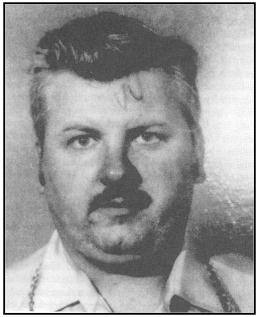
In the case of convicted and executed murdered John Wayne Gacy, who was given a lethal injection by the state of Illinois in 1994 for the murder of thirty-three young men and boys in the 1970s, one detective thinks that more bodies could still be found.  Sheriff Tom Dart wants permission to take another look at a backyard in Chicago where Gacy was once spotted with a shovel at 3:00am, but his request has been denied by Cook County State’s Attorney Anita Alvarez.

The yard was excavated once already, back in 1998, and nothing of significance was found.  However, Dart contends that only two possible spots were selected for the digging and radar had noted around a dozen unusual points under the surface.    For now, it appears that Sheriff Dart will need to come up with a more compelling reason to disturb that ground once again.

If there is some evidence to back up the claim that bodies may be buried in that yard in Chicago, I hope that authorities are given the opportunity to complete a more thorough search.  Even thirty or forty years after the fact, this may afford just one family the chance to allow a son, a brother, or a friend finally to rest in peace.

Do you think authorities should keep searching and digging for other victims?

* * *

Author Blog: https://authorjenniferchase.com/
Crime Watch Blog: http://emilystonecrimewatch.wordpress.com/
Book & Crime Talk:  http://blogtalkradio.com/jennifer-chase
Books: Compulsion  Dead Game  Dark Mind  Silent Partner  Screenwriting
Posted in Forensic, Serial Killers | Tagged , , , , , , | 6 Comments

Still a Child, but Serving Life in Prison

It’s a sad fact that kids are not only the victims of tragic violence in our country, but that they also are sometimes the perpetrators.  We’ve all seen stories of children who gun down their classmates in the middle of a school day or attack their parents or act out in dangerous ways against siblings or peers on the neighborhood.  Our justice system has long struggled with how to punish these youngest of offenders.  At what age can a kid committing an adult act of violence be considered an adult himself?  When is a child old enough for us to say she can spend the rest of her life in prison without the possibility of life outside bars, even if she is not yet old enough to drive?

Karen Franklin, PhD posted a sobering piece on her blog recently that examines the unique way in which the United States deals which juvenile criminals.  Did you know that there are currently more than 2500 Americans serving life without parole for crimes that they committed before reaching the age of eighteen?  There needs to be consequences in place for a violent act no matter the age of the assailant, to be sure, but it is stunning to imagine a young teenager who now will spend the next sixty years in jail.

The difficult topic of putting young people behind bars becomes even more complicated when you examine the backgrounds that the boys and girls bring to their violent acts.  Most of them experienced high levels of violence in their home environments and, as Franklin points out, three-fourths of the girls serving life sentences had been victims of sexual abuse.  These statistics are not meant to mitigate the horror of the violence that these teenagers did to land them a life sentence, but it does bring into question how we may better serve our children to prevent these crimes from occurring in the first place.

What are your thoughts on sentencing a juvenile to life in prison? 

Does a fourteen-year-old who commits murder deserve to lose his freedom until his death, or do kids need to be considered differently in our courtrooms?

* * *

Author Blog: https://authorjenniferchase.com/
Crime Watch Blog: http://emilystonecrimewatch.wordpress.com/
Book & Crime Talk:  http://blogtalkradio.com/jennifer-chase
Books: Compulsion  Dead Game  Dark Mind  Silent Partner  Screenwriting
Posted in crime | Tagged , , , , , , , | 7 Comments