Photography Sunday — Novel Inspired

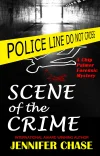
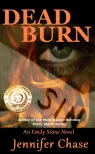
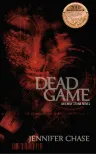
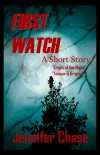
I love photography and I find it actually inspires storylines or specific scenes for a novel.  It’s a great way for me to change my perspective of work and to give myself a break.

I went back through some of my photo archives for the past six months and I realized that some of these photos inspire book covers.  They seem to express a mood or feeling for me.  What do you think?

Enjoy your weekend! 

Take some time out today to enjoy all the wonders!

Posted in Photography | Tagged , , , , | 1 Comment

Man Lives with Decomposing Body of Girlfriend

With all of the technological advancements that enter the field of forensics and assist members of law enforcement in bringing criminals to justice, it’s hard to imagine anyone will ever develop an instrument that can explain fully the psychology behind some of the violent acts committed around us.  I guess there always will be the question, “How could anyone do that?”

This very question can be asked of Erik Grumpelt, who had been living with the decomposing body of his girlfriend for two months before being arrested earlier this week.  Grumpelt admitted that he hit Malinda Raya several times in the abdomen after she admitted to cheating on him.  He left the apartment for a period of time and returned to find her unresponsive. 

Officers found her body on the bedroom floor, surrounded by air fresheners and carpet cleaner.  Grumpelt had continued to occupy the apartment the entire time, as a corpse remained within the same walls.  They made the discovery after Grumpelt wrote a letter to his dad confessing that he accidentally killed Raya.  He was arrested in Arizona on Monday and faces second-degree murder charges.

It really is a startling investigation into criminal behavior to spend time thinking about how a person can rationalize the presence of a corpse in their home.  Was he simply afraid of reporting the death to the authorities?  Did he not want to admit that his girlfriend was really dead?  Did he not notice the smell or become disturbed by the sight?

I cannot help but be drawn to forensic psychology for its terrifying elements as well as its fascinating qualities.  I continue to strive to learn more about what makes people act in the way they do, and hope that my lifelong studies are evident in the crime novels that I have written and that explore the mind’s motivation to violence and murder.   

* * *

Blog: www.authorjenniferchase.com/
Website: www.jenniferchase.vpweb.com/
Crime Watch Blog: www.emilystonecrimewatch.wordpress.com/
Book & Crime Talk: www.blogtalkradio.com/jennifer-chase/
Books: Compulsion = Dead Game = Silent Partner = Screenwriting

Posted in crime, Criminology | Tagged , , , , , | Leave a comment

How to Avoid the Mayhem of Redundant Words?

We all have a safety net of our own unique vocabulary.  These are the words that we’re comfortable with and they help to define our emotions, thoughts, and desires.  You could say that our comfortable word choices helps to define who we are as a person.  We are creatures of habit.

Words are strong.  Words can hurt, inspire, and incite.  “The pen is mightier than the sword”, holds words to an entire new meaning of truth.

I’m working on my third novel in my Emily Stone Series.  There are many emotions flowing through my body.  I’m excited that I’m going to complete book number three.  I’m tired of rereading the same sentence.  I’m exasperated to find another redundant word that I’ve used a million times in my story that I have to change. 

How did I get so simple with my words?  Is it my safety net of vocabulary words?  Do I really use that adjective so many times when I’m describing something?  Oh my!

Through the grueling process of rewrites, you discover many things about yourself as a person and as a writer.  I found myself using certain words on this novel where I had really dig deep into my psyche to find a more appropriate words.  The thesaurus is fine for most simple words, but I find that it doesn’t suffice for that particular adjective or description I need. 

For example, how many times can you use the word “cop”?  Well, you can say officer, police, fuzz, law enforcement personnel, policeman, policewoman, pig (I wouldn’t actually use that word), investigator, CSI, forensic tech, and police officer.  Basically, I mix it up in my story.

Some examples of overused words, the use of went, walked, moved, and talked.  There are more appropriate and colorful words, such as slithered, sauntered, traveled, departed, jogged, chatted, gabbed, encouraged, and stirred.  Of course, there are many more words, but you get the idea.

I decided a while back to write down a couple dozen words that I seem to be rather connected to and replace each one with ten to twenty words.  I have a nice redundant word cheat sheet.  I would highly recommend it to anyone writing a long article, novella or full length novel to take the first ten pages and highlight words that are either redundant or don’t give a punch.

What are some of your favorite redundant words that need some spicing up?

* * *

 Blog: www.authorjenniferchase.com/
Website: www.jenniferchase.vpweb.com/
Crime Watch Blog: www.emilystonecrimewatch.wordpress.com/
Book & Crime Talk: www.blogtalkradio.com/jennifer-chase/
Books: Compulsion = Dead Game = Silent Partner = Screenwriting      

Posted in Writing | Tagged , , , , , | 5 Comments

Should Some Children be Diagnosed a Psychopath?

Today it seems that we are so careful to be politically correct about some things that need to be addressed from a psychological and clinical point of view.  The thought of a small child or a teenager being diagnosed as a psychopath leaves of us cold and most don’t want to even approach the idea.  I absolutely shudder at the thought too. 

But what’s worse?  The unpopular, politically incorrect label or allowing a child to wreak havoc and mayhem on everyone around them when it could have been addressed and possibly cured early? 

Isn’t it putting off the inevitable?    

The American Psychiatric Association DSM-IV has no category that captures the diagnosis of psychopathic personality in children and adolescents.  It describes these characteristics as “Disruptive Behavioral Disorders” in three overlapping subcategories of attention-deficit hyperactivity disorder, conduct disorder, and oppositional defiant disorder.  Conduct disorder comes close to being described as psychopathic with traits of egocentricity, lack of empathy, lack of guilt, and lack of remorse. 

When we think of a psychopathic child a few movies come to mind, such as the Bad Seed and The Omen.  However, the reality is very real whether we want to believe it or not. 

How many headlines have we read where a child has killed or raped another child? 

Examples:

A teenage boy in Colorado waits patiently while two young friends hack and hammer his mother to death. 

Kansas City police are baffled by jealous 12-year-old who kills younger sister and mother over birthday party plans. 

Or, girl, 4, kills baby brothers by throwing them to the floor after one of the 3-week-old infants accidentally scratches her during play.  

There’s no easy answer how to approach this type of psychopathy in children and what it will mean when they reach adulthood, but I feel that if they are diagnosed with psychopathic tendencies early it won’t put off the foreseeable that awaits them later in life. 

Robert D. Hare, PhD states, “Psychopathic attitudes and behavior very likely are the result of the combination of biological factors and environmental forces”.

This is a hot topic for debate and the sides are passionately stated.  But, as we see more and more violent actions from children younger and younger, it proves that something needs to be reevaluated in mental health areas.

In my Emily Stone Series, the heroine deals with psychopathic individuals who haven’t received any mental evaluation or treatment as children.  The events are fictional, but isn’t life stranger and at times more violent than fiction? 

What do you think?  I would love to hear your comments.

* * *

Blog: www.authorjenniferchase.com/
Website: www.jenniferchase.vpweb.com/
Crime Watch Blog: www.emilystonecrimewatch.wordpress.com/
Book & Crime Talk: www.blogtalkradio.com/jennifer-chase/
Books: Compulsion = Dead Game = Silent Partner = Screenwriting 

Posted in Criminology, Serial Killers | Tagged , , , , , | 1 Comment

Puppy Dies After Being Left in Hot Car

If you are living in a part of the country that isn’t hot right now, then you are in the minority.  We have seen ongoing triple-digit temperatures in Dallas and Memphis and Chicago and New York, just to name a few, and July looks like it will be one of the five hottest in the history of the United States. 

Everyone is being asked to take precautions to protect their health during this dangerous time.  There are regular reminders about leaving children in a hot car, even for a minute, as there are tragic instances of little kids dying every summer while strapped into the backseat of a closed vehicle.  Let’s also remember, though, that a broiling car is no place for your pets, either.

Last week in California, a six-month-old puppy was left in a hot car and later died at the veterinary hospital.  The windows in the car had been cracked about two inches and there was no water available for Pomeranian/Shih Tzy mix.  Authorities estimates that the puppy had been in the car at least an hour and a half to two and a half hours.

The dog’s owner, TiAndra Davis, has been arrested for felony animal cruelty.  She was taken into custody at the Sacramento County jail on $10,000 bond.

I cannot imagine leaving a precious animal alone in a car to suffer and essentially suffocate to death in such extreme conditions.  All of you who know me or at least read this blog regularly know of my love for dogs.  My heart breaks with this story and I hope it serves as a wake-up call for others who may have found no harm in leaving their pet to wait for just a few minutes in a hot car while they make a quick trip into the store.

I will be anxious to see whether or not the justice system produces a guilty verdict in this case and the type of punishment that gets handed down.

Posted in crime, Police | Tagged , , , | 2 Comments

The Skillful Art of Interrogation

As with many things these days, the word “interrogation” has been replaced with “interview”.  I like to call it what it is, an interrogation.  Interrogative procedures are used to obtain a confession, admission of guilt, or illicit helpful information from a suspect in regard to an investigation.

In my Emily Stone Series, she rarely uses interrogation techniques.  However, she does use her skills in observation, criminal profiling, and crime scene investigation. 

I have met several police officers throughout my writing career and research and it’s amazing to observe how they question suspects as well as witnesses.  Each person has a way of relating to different people to make them feel comfortable or in the “hot” seat.  Let’s face it; it’s intimidating to be at a police department.  Being around police officers is like any other task for me, but I notice that other people get fidgety and look guilty even when they’re not. 

The main purpose of the police interrogation:

 1.                  Establish the innocence of a suspect(s) by clearing up facts that seem to point to guilt.

2.                  Obtain from the suspect(s) (from friends and family) the names of accomplices, facts surrounding the crime, follow up leads and alibi(s), location of physical evidence, or stolen goods.

3.                  Obtain from the suspect(s) an admission or confession.

It’s interesting that many people feel compelled to confess to their crime.  Especially when they are confronted with the accusation and the facts. 

The psychological works of Milton W. Horowitz helps to explain this phenomenon with five social-psychological conditions as to why people confess.

1.                  Accusation

The accusation may be explicit and made directly at the start of the interrogation.  It’s the attitude and demeanor from the investigator that the suspect feels cornered and there’s no other way out.

2.                  Evidence available

It’s the realization of the suspect that there is evidence available against them.  When hard evidence is produced, they have been “caught with the goods” and there’s no other way out.

3.                  Forces – friendly & hostile

When a suspect is dealing with friendly or hostile factors it causes a psychological uneasiness, which may be conducive to a confession.  The suspect must believe that he/she is alone, cut off, and feel that confessing is the only way out.

4.                  Guilty feelings

Many criminals don’t have guilty feelings (especially psychopaths), but some have the need to get a burden off their chest.

5.                  Confession – a way out 

Confessing is a multi-faced action.  People being interrogated are often unaware of their vulnerability and weakness until an authority accuses them.  In combination with evidence, their own guilt, mindful loneliness, and the need for relief of their burden.  Many people will confess as a way out.

* * *

Blog: www.authorjenniferchase.com/
Website: www.jenniferchase.vpweb.com/
Crime Watch Blog: www.emilystonecrimewatch.wordpress.com/
Book & Crime Talk: www.blogtalkradio.com/jennifer-chase/
Books: Compulsion = Dead Game = Silent Partner = Screenwriting

Posted in Criminology, Police | Tagged , , , , , | 7 Comments

My Personal Stab at Research

One of the things I stress about writing a novel is you must do your research.  It doesn’t matter if you’re writing fiction or non-fiction because research should be mandatory.  I actually love research.  You get to learn something brand new, if you’re really lucky you get to add a few new things to your writing arsenal. 

Here’s a recent example of my research, I have an upcoming character in my Emily Stone Series that is good at throwing knives.  I don’t mean the Ninja sword wielding kind of knife throwing, but just a guy who can hold his own by accurately throwing a knife.  Sounds simple enough.  Right?  Well not really… 

Here’s why… You don’t just pick up any kitchen knife, hurl it with all of your might, and expect to stick it to a target perfectly.  Why?  Knife throwing is a skill.  As with any skill, it takes practice and understanding. 

For me, I don’t care if I only mention a knife being thrown one time in a story or it revolves around an entire plot, I want to know the correct way to throw a knife.  So that’s what I did, I actually went to a knife store in a mall and bought a beginner set of 3 throwing knives.

Cool huh?

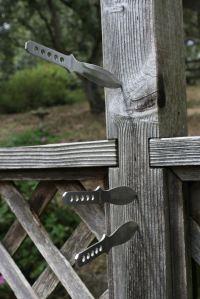
I actually thought so.  These stainless steel knives are about seven inches long and there isn’t a sharp edge (actual throwing knives are shown above in photo).  However, the end is mighty pointy and could hurt someone, or heaven forbid, you.  You still have to take some precaution when throwing any sharp, pointed object. 

Okay, enough of my public safety announcements.  

I looked up some basic information on the Internet, but finally settled on a handbook by Gil Hibben called The Complete Gil Hibben Knife Throwing Guide.  The booklet is about sixty pages with photographs.  He also has other books and offers a variety of hand made, well-crafted knives. 

When I got home and took my knives out of my purse (glad I didn’t have to go through any metal detector), it was tough not to start hurling my new throwing knives.  I quickly read the booklet to get the basic information and I was ready to go. 

Word of warning… it’s not as easy as it looks. 

Here are the basics: grip, stance, presentation, and release.  Once you get quite a few throws under your belt, you begin to get a feel for the exercise and will develop your own throwing style.  And voila, I began to stick more than half of my throws and gradually improved my accuracy.  Your throwing arm will be sore the next day if you overdue the new skill. 

Just so you know, if a knife sticks out perfectly level (level, horizontal), that’s a correct hit and proper distance from target.  If the handle is up or down, then you need to adjust your distance to the target.     

You have already learned something new today!  See, research is fun and you should take advantage of digging up answers whenever you can.  In my case, slicing through the information or cutting to the meat of the story to get my research accomplished.

If you’re curious about how and when I’m going to incorporate knife throwing into my novels, check out Compulsion or Dead Game to get caught up with Emily Stone and her vigilante methods of hunting down serial killers.  

* * *

Blog: www.authorjenniferchase.com/
Website: www.jenniferchase.vpweb.com/
Crime Watch Blog: www.emilystonecrimewatch.wordpress.com/
Book & Crime Talk: www.blogtalkradio.com/jennifer-chase/
Books: Compulsion = Dead Game = Silent Partner = Screenwriting
Posted in Compulsion, Dead Game, Writing | Tagged , , , , , | 1 Comment