Unabomber’s Personal Items to Be Put Up for Auction

I recently published a blog post about an upcoming auction of some of John Wayne Gacy’s paintings, with the proceeds from the sale being donated to charities intended to benefit the victims of his crimes.  Now, the U.S. Marshals will be auctioning off many of Ted Kaczynski’s personal items as a way of compensating some of his victims.

Most of you are more familiar with Kaczynski as “The Unabomber,” the man who killed three people and injured twenty-three others from 1978 to 1995.  His twisted mission was to protest against technology and the destruction of wilderness.  The original targets of his violence were people associated with UNiversities and Airlines, causing the FBI to develop the nickname of “UNAbomber.”  He was arrested after his 35,000-word manifesto was published in both The New York Times and The Washington Post and his brother provided other letters that were proven to be a linguistic match.

The auction was approved by the courts two years ago, but Kaczynski held up its progress with the challenge that he had not had the opportunity to quality check the personal documents that were set to be included in the sale.  Also, there had to be care given to protect the privacy of the victims, including detailed writings about the injuries they sustained.

The auction runs from May 18 to June 2, so if you have always wanted to own the Unabomber’s birth certificate or one of his typewriters, now is your chance.

Several of his victims are still owed a total of $15 million in compensation and hope that this auction will lead to those payments finally being made.  At least, in this instance, perhaps some good and some closure can come from a horrible situation.

Posted in crime | Tagged , , , , | Leave a comment

What Exactly is a Death Investigator?

Death investigation is the most important aspect of a medical examiner, coroner, or death investigator’s basic professional duty.  Death investigators play a key role in all types of death scenes; they contribute to the successful death scene investigation along with, but not limited to police officers, emergency personnel, hospital personnel, police detectives, forensic pathologists, funeral directors, and family members. 

The death investigation team is extremely important to provide thorough and specialized services for the well-being and health of the general public.  The ultimate success depends upon the knowledge and expertise of all these individuals combined.           

What is a death investigation? 

Simply stated, a death investigation is the procedure in which a death investigator determines the cause and manner of death. Death investigations are divided into four categories: natural, suicide, accident, and homicide.  Also, “undetermined” can be, but rarely used. 

The importance of death investigations has been well established since the Egyptians and Babylonians used their somewhat considerable knowledge of the human anatomy to record the cause of death, dating back as early as 1850 B.C. 

In 44 B.C., a Roman physician examined the body of Julius Caesar and counted twenty-three stab wounds.  He further stated that only one stab wound to the chest had been the fatal wound that took his life.

An interesting thirteenth century book from China, His Yuan Chi Lu, that means “the washing away of wrongs”, has been established as the oldest legal medicine book ever written.  It has been compared to the “Instruction to Coroners” that outlines details and procedures in the investigations of suspicious deaths.

The development of forensic medicine in the United States was primarily established in 1883 with the beginning of a new medicolegal investigative system.  In 1915, the actual title of “medical examiner” was established and implemented into investigations.  

Currently, the field of forensic medicine utilizes many types of technology and computers to establish the manner and cause of death with specific detection tests.  The standards of inspection and accreditation of the medical examiner’s offices that are currently used today was originally founded by Milton Helpern, M.D. with The National Association of Medical Examiners in 1966.        

The history of death investigators has proved to be important in the process of death investigations and how they are completed today.  However, death investigations are not only used for criminal cases such as homicide, but their duties also entail closer examination into accident prevention, substance abuse, child abuse, and motor vehicle accidents. 

When is it necessary to contact a death investigator? 

A death investigator should always be contacted for any death because it is their responsibility to determine the cause and manner of death, time of death, and signing of the death certificate. 

The flow of death scene management begins when there is a death and an individual finds a body and calls the police.  Emergency personnel arrive and the scene is then examined and aid is rendered if applicable.  During this time, the death investigator, and if necessary a forensic pathologist, is contacted.  The death investigator may examine the body at the actual scene before approving the removal of the body.  Depending upon the circumstances of the death, the body may either be moved to the funeral home or morgue for an autopsy.      

It is essential that death investigators develop good working relationships with the other death scene professionals.  Once the death investigator is called, they may ask for a complete description of the scene and the condition of the body.  After determining the facts of the death, the death investigator will decide if they will visit the death scene personally or wait until the body is moved to either a funeral home or morgue.  However, the death investigator may ask questions over the phone or direct the caller to further investigation of the scene before making a final decision.         

Here are some great books for more information about death investigation:

Coroner at Large

By Thomas T. Noguchi, M.D.

Crime Science, Methods of Forensic Detection

By John F. Fischer & Joe Nickell

Death Investigation: The Basics

By Brad Randall, M.D.

What the Corpse Revealed

By Hugh Miller
Posted in Forensic | Tagged , , , , | 1 Comment

Photography Sunday — Trees in the Park

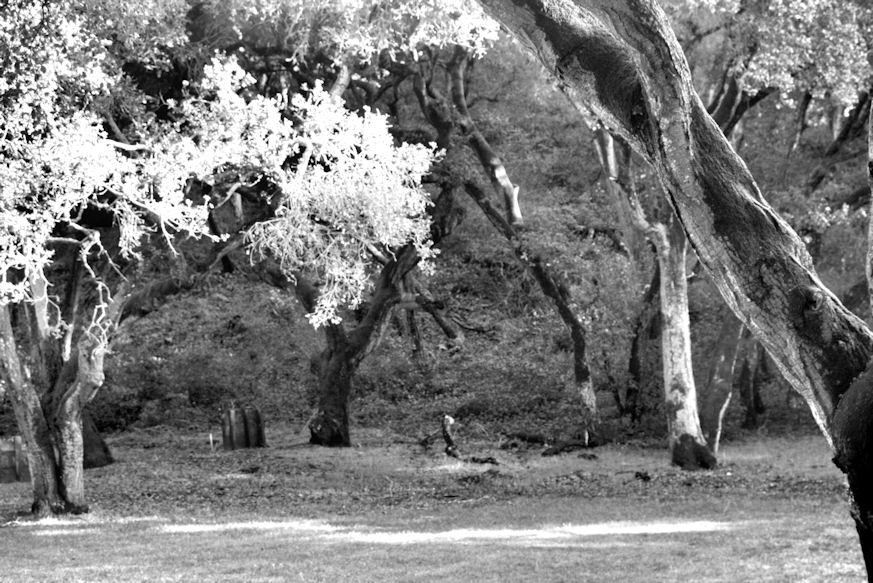
I walk through this local park regularly.  There are tons of Oak trees, each are uniquely different from the next.  On this particular afternoon in December, the lighting was extremely dramatic.  I took several shots bracketing my shutter and Fstop with my Canon EOS Rebel SLR Digital camera.  I settled on F4.4 and 1/28 sec.

Enjoy your Sunday!

Posted in Photography | Tagged , , , | Leave a comment

Serial Killer’s Paintings to Be Sold for Charity

Criminals who are waiting out their time on death row engage in a variety of activities to make the days pass.  Some read countless law books in hopes of finding a way to appeal their sentence.  Others take up writing or music in the limited ways that their circumstances will allow.  Serial killer John Wayne Gacy painted . . . a lot . . . during the sixteen years between his capture and his execution.  An art studio in Las Vegas is preparing to auction 74 of Gacy’s pieces for charity, and some people are not happy about it.

One of the charities that is supposed to receive some of the proceeds from the sale, the National Center for Victims of Crime, wants nothing to do with the auction and asked for a cease and desist order that will remove their organization from having an association with the event.    The coordinator of the show has countered that he is just trying to “help from something that was bad.”

Gacy is infamous for raping and murdering 33 boys and young men between 1972 and 1978.  One of the most disturbing details about this man is the fact that he dressed up as Pogo the Clown to entertain children at various events.  In fact, one of the most controversial pieces up for sale at the auction is a self-portrait that Gacy drew of himself as Pogo.

What do you think of this effort to sell a serial killer’s artwork as a way of raising money for charity?  Is this, as the proprietor of the gallery indicated, an attempt to make some good out of a bad situation?  Or, are we only offering more publicity to a man who committed heinous acts and who should be left dead and buried?

Posted in Serial Killers | Tagged , , , , , | 1 Comment

Writing as a Lone Wolf or Being a Part of the Pack

As a writer, you have many options to consider besides what and how you’re going to write.  You can join a writing group, take a class, network with other writers online, bounce ideas off of your best friend, but ultimately writing is an endeavor that’s predominantly solitary.

If you look up the word “solitary”, there are so many lonely words that are associated with it, such as, preferring solitude, lone wolf, lonely existence, a solitary walk, lacking companions, hermit, recluse, and basically someone without others. 

That seems really depressing to me to look at it that way.  Then that would mean a writer is a solitary creature that must live a lonely existence in order to take that solitary walk.  I don’t think so…   

I choose to look at the long, arduous task of writing a full-length novel as stepping into a fantastic adventure where you are at the helm and can make all the decisions to help your characters get through their thrilling adventure.  Some characters may survive while others fall by the wayside, some may succeed just as others will failure.  It’s all at your discretion.  Technically, you’re not really alone I suppose.  Okay, maybe I seem like the term “lone wolf”, but you get the picture.

Writing definitely isn’t for everyone.  I do enjoy my time writing and can’t imagine myself being happy doing anything else, but I also try and balance my time with other activities, projects, and social engagements.  One of the things that I love the most is my constant companions that are always at my side when I write.  My two Labrador retrievers are always there for me to make me laugh, remind me that it’s time to go for a much needed walk, and to remember that there are important things in life.  They are truly my unwavering writing support team.

My advice to anyone thinking about writing a book or deciding to take up the solitary life of a writer is to remember that you’re not really alone.  Take the time to incorporate fun activities in your schedule.  And most of all, don’t forget to get back to writing!

Posted in Writing | Tagged , , , , , , | 1 Comment

How Important is Impression Evidence?

There is no branch of detective science that is so important and so much neglected as the art of tracing footsteps”, simply stated by the fictional detective character, Sherlock Holmes, from A Study in Scarlet written in 1881. 

How important is impression evidence?

The shortest answer, it is extremely important to any crime scene investigation.

I find the various types of impression evidence to be a fascinating study in crime scene investigation.  This is the one area, with exception to the study of the psychological aspect of a criminal, which really piques my forensic interest.  Impression evidence comparison is based upon the details of the particular object of interest that can be examined for distinctive and unique details.  

Various impression evidence left behind at a crime scene is similar to fingerprint evidence in that it is in two or three-dimensional form. The most common types of pattern evidence found at a crime scene are footwear and tire track imprints and impressions.  Footprints or tire tracks can lead investigators through the actual path that the criminal took, to finding secondary crime scenes, and even indicating the criminal’s height, or whether they were running or walking. 

It is imperative that the crime scene detective be attentive and mindful of not disturbing any of these types of important impression evidence so that each clue can be documented, collected, and preserved.

What falls into the impression or pattern evidence category? 

  • Footwear Imprints/Impressions in dirt, mud, or snow
  • Tire Track Imprints/Impressions in dirt, mud, or snow
  • Bite Marks found on a victim or food items
  • Lip and Ear Impressions
  • Fingerprints
  • Glove Prints
  • Tool Mark Impressions from prying, breaking, cutting, and scraping a surface
  • Shoe Impressions
  • Barefoot/Sock and Foot Impressions
  • Contusion and Abrasion Patterns
  • Fabric Impression/Transfers
  • Various Typed Documents

Imprints are two-dimensional markings that have only length and width; they are usually made in residue, such as blood, dust or mud and can either be positive or negative markings.  Impressions are three-dimensional markings that have length, width and depth. They are most commonly found in soil, sand, or snow and are negative markings.

The most common methods of collecting, documenting and preserving impression evidence includes the various processes:

  • Seizure of a particular item (e.g. doors, window glass, sections of flooring, etc.) containing the imprint/impression.
  • Photographing the imprint/impression at the scene utilizing special photographic and lighting techniques.
  • Making a cast of the impression using various casting materials and methods (e.g., dental stone, plaster of paris, or paraffin wax).
  • Lifting imprints using appropriate materials and equipment (e.g. rubber or adhesive lifters, Electrostatic Dust Lifter, fingerprint dusting powders, etc.).
  • Enhancement of particular areas to develop latent or low quality imprints using various chemicals and alternate light sources.

In 1968, James W. Osterburg, author of many criminal investigation textbooks wrote this in his preface of his first edition of “The Crime Laboratory, Case Studies of Scientific Criminal Investigation”, wrote “The adaptation of science to the needs of the law seems an obvious step that must be employed to assist in the administration of justice.  However, with the exception of medicine, only in recent times has science been enlisted to enlighten the problems of investigation and proof in criminal law.”


Jennifer Chase
Award Winning Author & Criminologist

Blog: www.authorjenniferchase.com/

Book & Crime Talk: www.blogtalkradio.com/jennifer-chase/ 

Posted in Forensic | Tagged , , , , , | Leave a comment

Top Forensic Books on my Bookshelf

Recently, a few people have asked me about non-fiction books that I would recommend for reading more about crime scene investigation and serial killers.  Here are some of the top books that I refer to often in my work and I also find them extremely interesting. 

Case Homicides: Practical Investigative Techniques

By Richard H. Walton

This is a great book that outlines actual cases and how to conduct cold case investigations.  You really view homicides in a different light.  I would recommend this book for anyone who wants to write about a fictional cold case detective.

Crime Reconstruction

By Jerry Chisum & Brent E. Turvey

This is by far one of the more interesting books I’ve read about crime scenes.  The book talks about staged crime scenes and actually reconstructing a crime scene for an investigation. 

Criminal Profiling

By Brent Turvey

I love this book.  There is so much information about profiling to digest that it makes a wonderful reference book for writing in the crime fiction genre.  This is definitely not a light read, but it is worth your time.

Serial Killers

By Joel Norris

This was one of the first books I read about serial killers.  It talks about the how and why serial killers do what they do.  It really piqued my interest to learn more about this phenomenon.  Norris has some interesting theories and I’ve incorporated some of them into my novel “Compulsion”.  

Techniques of Crime Scene Investigation

By Barry A.J. Fisher 

This is a perfect overall academic book for anyone interested in the various areas of crime scene investigation and forensics.  This book is often used in college course work and it is a great beginning book on crime scene investigation.  This book is informative and I highly recommend it. 

Without Conscience: The Disturbing World of the Psychopaths Among Us

By Robert D. Hare, PhD

I found this book to be one of those you casually pick up to read and then you can’t put it down!  It’s frightening, but enlightening at the same time.  If you’re interested in the psychology of a psychopath, I would recommend this book.  It’s an easy to read paperback.

Do you have any favorite forensic or crime scene investigation books?  Please feel free to leave your selection in the comments.  I would love to hear from you.

Jennifer Chase
Award Winning Author & Criminologist
Posted in Forensic | Tagged , , , , , | 2 Comments